
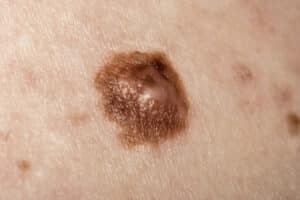
Skin growths can cause concern, especially when they appear suddenly or change over time. Many adults develop harmless seborrheic keratoses. However, some growths may resemble more serious conditions and require medical evaluation. Understanding the differences helps you make informed decisions about your skin health.
At ProDerm Skin and Surgery, Dr. Sydney Larkin Proffer provides expert diagnostic care, supported by board certification in dermatology and fellowship training in Micrographic Surgery and Dermato-Oncology at Northwestern University. She also completed a competitive dermatology residency at the Mayo Clinic Alix School of Medicine and holds a Master of Science in Health Care Delivery. Her double-board certification advanced expertise in Mohs surgery, dermoscopy, and cosmetic and medical dermatology allows her to evaluate both benign and potentially serious lesions with precision.
Understanding Seborrheic Keratosis
Seborrheic keratoses are common benign skin growths. They often appear as waxy or textured spots that seem to sit on the skin’s surface. While their appearance may be concerning, they do not develop into cancer.
These growths often develop on the chest, back, head, or neck. They can vary in color from tan to dark brown. Many people notice more lesions as they age, particularly after age forty.
Key Signs of Seborrheic Keratosis
Seborrheic keratoses share several distinguishing traits. Consider the following common features:
- They often have a waxy or stuck-on appearance.
- They may be flat or raised and can feel rough or scaly.
- They can itch or rub against clothing, but are not usually painful.
- They appear in multiple locations except the palms and soles.
- Their color ranges from light tan to nearly black.
Recognizing these features helps you understand whether a lesion may be benign. If anything seems unusual, a dermatologist should examine it.
Signs a Skin Growth May Be Something More Serious
Some warning signs may indicate that a growth requires medical evaluation. Here are key features to watch for:
- Rapid growth or sudden appearance.
- Irregular borders or asymmetry.
- Multiple colors in a single lesion.
- Bleeding without cause.
- Pain or persistent itching.
- Changes in size, shape, or texture over time.
- A lesion that looks different from your other growths.
These signs do not confirm skin cancer, but help identify the need for prompt assessment. Early evaluation supports better outcomes.
Diagnostic Evaluation at ProDerm Skin and Surgery
Dr. Proffer performs thorough skin examinations to determine whether a lesion is benign or requires further testing. Her advanced background in dermato-oncology and Mohs surgery equips her to assess complex cases.
Some evaluations may include a dermoscopic examination or a biopsy. These tools ensure accurate diagnosis and appropriate treatment. Patients receive clear explanations and recommendations tailored to their concerns.
Schedule an Evaluation for Skin Growths in Austin
If you have a new or changing skin growth, ProDerm Skin and Surgery can help. Contact Dr. Sydney Larkin Proffer in Austin, TX at 512-535-6000 to schedule an appointment and receive expert skin evaluation and care.