
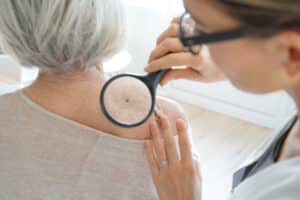
Mohs surgery is commonly used to address basal cell and squamous cell carcinoma, particularly when a tumor is large, aggressive, recurrent, or located where saving healthy skin matters. It may also be considered for certain melanomas and rarer skin cancers, depending on the diagnosis and other clinical factors.
Austin residents can receive specialized skin cancer care at ProDerm Skin & Surgery. The practice is led by Dr. Sydney Larkin Proffer, a board-certified dermatologist who completed her dermatology residency at Mayo Clinic and pursued advanced fellowship training in Mohs micrographic surgery and dermato-oncology at Northwestern University.
Learn more about conditions that Mohs surgery can treat below.
Basal Cell Carcinoma
Basal cell carcinoma, or BCC, is the most common skin cancer and one of the cancers most frequently treated with Mohs surgery. It typically grows slowly and rarely spreads to distant parts of the body, but an untreated tumor can damage nearby skin, cartilage, bone, or other structures.
Mohs may be recommended when a BCC:
- Develops on the nose, eyelid, lip, ear, scalp, hand, or another sensitive area
- Has indistinct borders
- Is large, increasing in size quickly, or likely to extend deeply
- Has returned after earlier treatment
- Has an aggressive growth pattern
Removing and examining one thin layer at a time helps the surgeon trace cancer cells while preserving as much unaffected tissue as possible.
Squamous Cell Carcinoma
Squamous cell carcinoma, or SCC, is another common reason for Mohs surgery. SCC can grow more aggressively than BCC and has a greater risk of spreading, especially when it’s large, recurrent, rapidly growing, or located on the ear, lip, scalp, or genital region.
Mohs allows the surgical margin to be checked during the procedure. Another layer is removed only from areas where cancer cells remain, which can be especially useful when the tumor’s edges aren’t easy to see.
Can Mohs Surgery Treat Melanoma?
Mohs surgery can be used for select melanomas, but it isn’t the right choice for every case. It may be considered for certain early melanomas, particularly melanoma in situ or lentigo maligna, on the head, neck, hands, or other areas where removing a wider margin could affect function or appearance.
Special laboratory stains are generally needed to help the surgeon identify melanoma cells. The treatment decision depends on the subtype, depth, location, and stage. Melanoma that has grown deeply or spread beyond the skin often requires additional care.
What Rare Skin Cancers May Qualify?
Mohs may also be used for uncommon cancers such as dermatofibrosarcoma protuberans, sebaceous carcinoma, extramammary Paget disease, and Merkel cell carcinoma. These diagnoses require individual evaluation because treatment needs can vary considerably.
How Is the Right Treatment Chosen?
Your diagnosis alone doesn’t determine whether Mohs surgery is the most appropriate solution. The tumor’s size, location, borders, growth pattern, history, and biopsy findings all matter.
For an evaluation with Dr. Sydney Proffer at ProDerm Skin & Surgery in Austin, TX, contact us online or call (512) 535-6000 to discuss your options.